

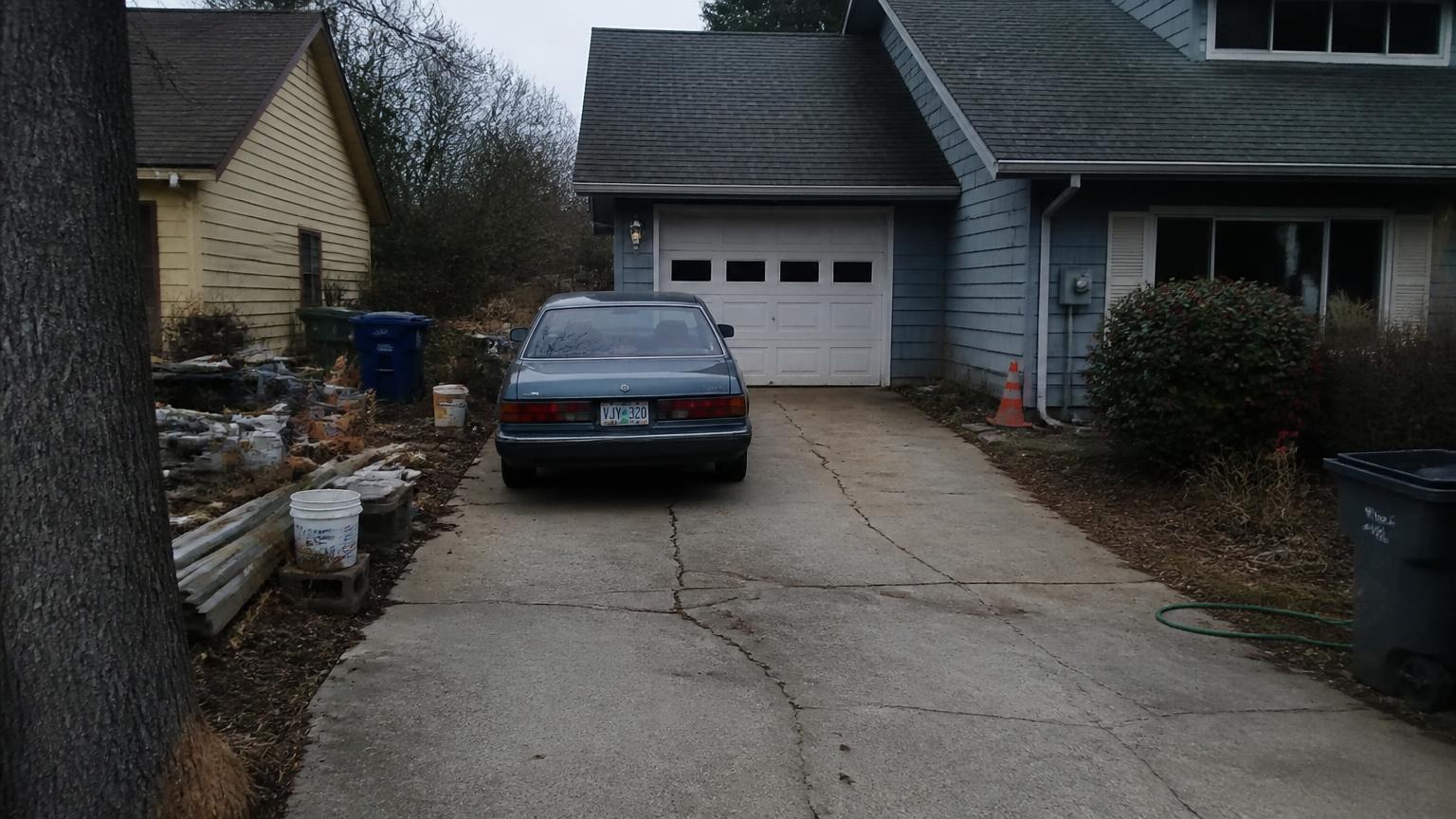
Read the property before the door opens
The property starts giving you information before anyone opens the front door.
A cracked driveway may limit where you can place a truck or dumpster. A locked gate can prevent the crew from reaching the work area. A loose dog can shut down the job entirely. Cars, low branches, narrow streets, overhead power lines, stacked debris, and damaged fences can all change how safely and efficiently the work can be completed.
These details are easy to overlook during the sales appointment. They become impossible to ignore when a crew, delivery truck, or equipment operator arrives.
Learning to read the property is not about judging the homeowner. It is about identifying conditions that could affect safety, access, scheduling, cost, and responsibility.
The driveway is often your first jobsite inspection.
Start before you park
Your evaluation should begin as you approach the property.
Look at the width of the street, available parking, nearby intersections, posted restrictions, steep grades, and the distance between the street and the work area.
Ask yourself:
Can a material truck safely enter and exit?
Is there enough space for a dumpster or trailer?
Will equipment block traffic or neighboring driveways?
Are permits required for street parking or material placement?
Are there low trees, wires, carports, or roof overhangs?
Can emergency vehicles still reach the property?
Will the crew need to carry materials farther than expected?
A project with easy access and a project requiring workers to carry every bundle 150 feet should not be priced as if they are the same job.
Extra handling means extra labor. It may also increase the risk of property damage and injury.
The driveway is part of the jobsite
Do not assume the driveway can support whatever you plan to place on it.
Older concrete may already be cracked, lifted, stained, or deteriorated. Asphalt can soften in hot weather. Decorative pavers may shift under heavy loads. Septic tanks, drainage systems, utility lines, or unsupported areas may be hidden underneath.
Before using the driveway for trucks, lifts, dumpsters, or material storage:
Photograph existing cracks and damage
Identify underground systems when relevant
Confirm equipment weight and clearance
Ask where the customer allows vehicles and materials
Use protective boards or barriers when appropriate
Keep heavy loads away from questionable areas
Document any restrictions in the proposal or job notes
A preexisting crack that was never photographed can quickly become “damage caused by the contractor.”
Documentation is cheaper than arguing.
Look for obstacles along the access route
The path from the street to the work area matters just as much as the work area itself.
Walk the route the crew will use. Look for:
Locked gates
Narrow side yards
Damaged steps
Loose handrails
Low rooflines
Air-conditioning equipment
Gas meters and electrical panels
Irrigation lines
Planters and decorative features
Stacked materials or debris
Children’s toys and outdoor furniture
Slippery or uneven surfaces
Do not rely on someone saying, “There’s plenty of room on the side.”
Measure it.
A ladder, wheelbarrow, sheet of plywood, roofing cart, or piece of equipment may require more clearance than a person walking sideways through a gate.
If the route must be cleared before work begins, decide who is responsible. Put that responsibility in writing.
Loose dogs are a work-stoppage issue
A friendly dog is still an uncontrolled animal.
Workers should not be expected to enter a yard with a loose dog because the homeowner says, “He doesn’t bite.” Delivery drivers, inspectors, subcontractors, and crew members do not know the animal, and the animal does not know them.
Dogs can also escape through gates that workers must repeatedly open. Even if no one is bitten, chasing a homeowner’s dog through the neighborhood is not part of the contract.
Before the job begins, require pets to be:
Kept inside the home
Secured in a separate enclosed area
Placed in a kennel
Removed from the property during working hours
The requirement should apply for the entire time workers are present—not only when they first arrive.
If an animal is loose and cannot be secured, the crew should have authority to stop work and leave the property. Any resulting delay or remobilization cost should be documented.
Safety beats awkwardness.
Locked gates and dead deadbolts cost time
A crew arriving at 7:00 a.m. cannot begin work if the only gate is locked and the homeowner is not answering the phone.
The same problem occurs when access depends on a broken latch, missing key, dead keypad, blocked door, or tenant who was never told about the project.
Confirm access before scheduling:
Which entrance will the crew use?
Will the customer need to be home?
Who has the key, code, or remote?
Are there tenants or occupants who must be notified?
Are any locks unreliable?
Will gates need to remain open?
How will the property be secured at the end of each day?
Do not ask customers to send sensitive entry codes through unsecured job notes visible to everyone. Limit access information to the people who actually need it and update or remove it after the project.
If the customer must provide access, state what happens when access is unavailable. The crew should not lose half a day because no one planned how to open the gate.
Clutter changes the risk
Debris, buckets, stored materials, abandoned equipment, and overgrown vegetation can restrict access and create trip, fire, or puncture hazards.
Again, the condition of the property is not a judgment about the customer. It is an operational fact.
Determine whether the area must be cleared before your crew arrives. If your company agrees to move items, specify:
Exactly what will be moved
Where it will be placed
Whether the customer must supervise
Whether fragile or valuable items are excluded
Whether there is an additional labor or disposal charge
Never allow employees to casually dispose of unidentified containers, chemicals, paint, fuel, or personal property.
“Get rid of everything on the side” is not clear authorization.
Take photographs and obtain written instructions.
Check the overhead and underground hazards
Contractors tend to focus on what is directly in front of them. Equipment operators and delivery drivers also need to know what is above and below them.
Look for:
Overhead electrical lines
Communication cables
Low branches
Roof overhangs
Carports
Underground utilities
Septic systems
Drainage lines
Irrigation
Soft or recently filled soil
Unmarked private electrical or gas lines
A boom, ladder, raised dump bed, or material conveyor can contact an overhead line. A dumpster or heavy truck can damage underground systems that were never designed to carry that weight.
When the location of a hazard is uncertain, do not guess. Confirm it before equipment enters the property.
Notice how the property is maintained—but don’t play detective
Site conditions can tell you how much preparation and protection the job may require. They cannot reliably tell you whether someone will be a good customer or whether they can afford the project.
An older car does not prove financial trouble. A spotless driveway does not guarantee payment. A cluttered yard does not make someone dishonest. A beautiful property can still produce a nightmare job.
Use observable conditions to make operational decisions—not personal assumptions.
Relevant observations include:
Existing property damage
Access limitations
Safety hazards
Items requiring protection
Conditions that may delay the work
Areas that cannot support equipment
Customer responsibilities that must be completed beforehand
Stick to what you can see, photograph, measure, and document.
The goal is risk assessment, not amateur psychology.
Put access requirements in the proposal
If access conditions affect the work, they belong in the agreement.
A simple site-access provision can say:
Site Access and Preparation: The customer will provide safe, unobstructed access to the work area during scheduled working hours. Before work begins, the customer must secure pets, unlock required gates, relocate vehicles, and remove personal property from designated access and work areas. Delays, additional labor, equipment changes, or return trips caused by unavailable or unsafe access may result in additional charges and schedule adjustments.
Customize the language for the project and any applicable contract requirements.
Then include property-specific notes:
Driveway must remain clear from 7:00 a.m. to 5:00 p.m.
Homeowner will move both vehicles before material delivery.
Dog must remain indoors while workers are present.
Side gate must be unlocked each workday.
Contractor is not authorized to place equipment on decorative pavers.
Customer will remove stored items from the east side yard.
Street-use permit is required before dumpster delivery.
General contract language establishes the rule. Specific job notes make the rule usable.
Perform a pre-job access check
Conditions can change between the estimate and the start date.
A vehicle may become inoperable. A gate may be replaced. New materials may be stored in the side yard. Landscaping work may block the original equipment route.
Before mobilization, confirm:
The delivery and equipment route
Parking and staging locations
Gate, door, and property access
Pet-security arrangements
Vehicle-removal requirements
Areas needing protection
Existing property damage
Customer preparation responsibilities
For complicated projects, review the site again before ordering materials or scheduling specialized equipment.
Ten minutes of confirmation can prevent an entire crew from standing around on the clock.
The bottom line
The job begins at the curb—not at the roof, electrical panel, plumbing fixture, or area being repaired.
A driveway, gate, side yard, or access route can reveal conditions that affect labor, safety, equipment, scheduling, and property protection. The earlier you identify those conditions, the easier they are to manage.
Observe the property. Photograph existing conditions. Measure the access route. Confirm who must move what. Put the requirements in writing. Recheck everything before the crew arrives.
The property usually tells you what the customer forgets to mention.
You just have to read it before you price the job.
The short version
- The job begins at the curb, not at the repair area.
- Access conditions affect labor, safety, equipment, and scheduling.
- Photograph existing conditions and confirm access before mobilization.
- Put access requirements in the proposal, then add property-specific notes.
- Use observable conditions for risk assessment, not personal assumptions.