

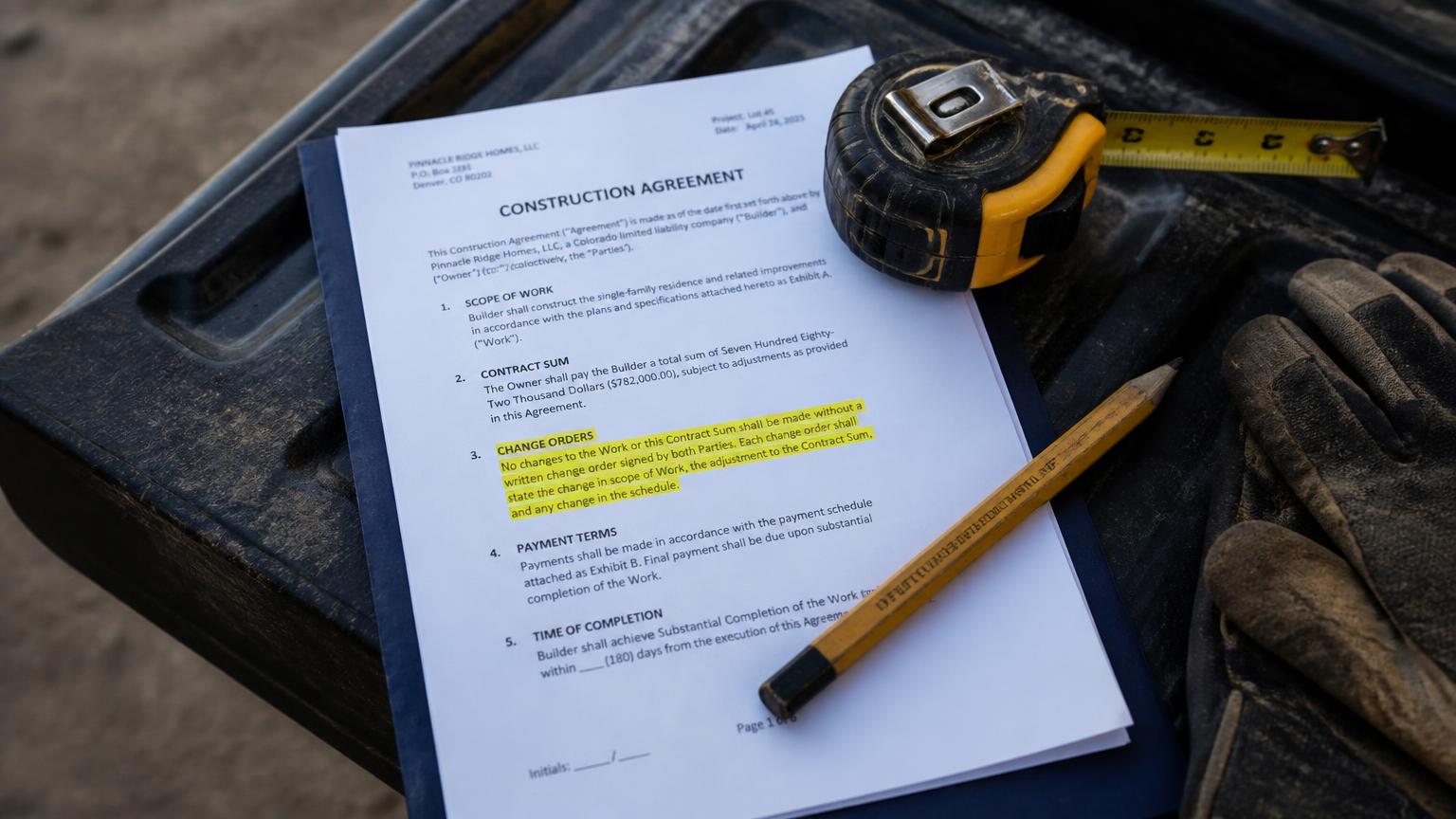
How scope creep begins
Scope creep rarely arrives as a major request.
It usually begins with something that sounds harmless:
“While you’re already here, can you take care of this?”
“Could your crew move that over a few feet?”
“We thought that was included.”
One small favor becomes three. Three become an extra day of labor. Materials disappear, the schedule slips, and the contractor ends up performing work that was never included in the price.
The customer may believe the change is minor. The contractor knows that even a minor change can affect labor, materials, permits, scheduling, equipment, subcontractors, and warranty responsibility.
If those changes are not documented and priced before the work begins, someone will eventually be unhappy.
Usually, it is the person paying the crew.
What scope creep actually looks like
Scope creep is any work added to or changed from the original agreement without a corresponding adjustment to the price, schedule, or both.
Common examples include:
Repairing damage discovered after demolition
Upgrading materials after the contract is signed
Adding work in another area of the property
Moving equipment, fixtures, vents, or utilities
Performing finish work that was not listed
Correcting another contractor’s work
Completing homeowner preparation that was supposed to be done before arrival
Repeating completed work because the customer changed their mind
Handling permit or code requirements that could not reasonably be identified beforehand
Not every change is caused by a demanding customer. Some are the result of hidden conditions, incomplete plans, code requirements, supplier changes, or simple misunderstandings.
The cause matters less than the response.
When the work changes, the agreement must change with it.
The small favor problem
Contractors often accept small additions because they want to provide good service. That is not automatically a mistake.
The mistake is allowing customers to believe additional work is automatically included.
A five-minute favor may be harmless. A favor involving two workers, setup, materials, cleanup, and responsibility for the finished result is not five minutes. It is additional work—and additional work has a cost.
Once you perform the first undocumented extra, it becomes harder to charge for the next one. The customer begins treating flexibility as part of the original deal.
That is how a profitable project gets nibbled to death.
Good customer service does not require unlimited free labor. It requires clear communication and fair expectations.
Your scope must be specific
A change-order clause cannot rescue a vague proposal.
Your original quote should clearly identify:
The work being performed
The areas included
The materials or product specifications
The quantity or estimated quantity
The preparation and cleanup included
The work specifically excluded
The conditions assumed when calculating the price
The customer’s responsibilities before work begins
Avoid descriptions such as “complete roof work,” “repair as necessary,” or “finish the project.” Those phrases leave too much room for interpretation.
Use measurable descriptions whenever possible.
Instead of writing:
Replace damaged wood as needed.
Write:
Price includes replacement of up to 100 square feet of damaged roof decking. Additional decking replacement requires customer approval and will be charged at the stated unit price.
The second version tells everyone where the original price ends.
The one paragraph that stops scope creep
A change-order clause does not need to occupy half the contract. It needs to be clear, visible, and consistently enforced.
Use language like this on every quote:
Changes and Additional Work: This price includes only the work specifically listed in this proposal. Any change, additional work, concealed condition, code requirement, or customer request outside the listed scope may result in an adjustment to the contract price and completion schedule. Additional work will not begin until the change and its price are described in writing and approved by the customer and contractor. Verbal requests, jobsite conversations, and work performed by others do not modify this agreement.
That paragraph establishes four important rules:
The quoted price applies only to the listed work.
Changes may affect both price and schedule.
Additional work requires written approval.
Verbal conversations do not silently rewrite the contract.
It fits on a phone screen, can be reused on every proposal, and is understandable without a law degree.
A clause is useless if you ignore it
The paragraph only works when your team follows it.
When a customer requests something outside the scope, the crew should not automatically agree to perform it. The response should be simple:
“We can take care of that. It isn’t included in the current scope, so I’ll have the office send you a change order with the price and any schedule adjustment.”
That answer is professional, helpful, and clear.
Do not wait until the end of the project to produce a list of extras. Customers hate surprise invoices, even when the charges are legitimate.
Document the change before the work begins.
For each change, record:
The additional or revised work
The reason for the change
The added or deducted price
The effect on the completion schedule
Any material or warranty changes
The customer’s written approval
Approval can be collected through your contract software, CRM, email, or another method permitted for your project. The important part is creating a record both parties can review later.
For regulated home-improvement work, confirm that your change-order process and forms meet the requirements of the state where the project is located.
What about emergencies and hidden damage?
Sometimes work must stop immediately because the crew discovers rot, structural damage, unsafe wiring, mold, code violations, or another concealed condition.
Do not cover it up and keep moving.
Pause the affected work, photograph the condition, explain the issue, and provide options. If temporary protection is needed to prevent further damage, document what was done and why.
Hidden conditions are exactly why the change-order clause exists.
The customer may be frustrated by the additional expense, but frustration is easier to manage when you provide evidence and communicate before charging them.
Photographs, measurements, supplier documents, inspection notes, and code references turn a difficult conversation into a factual one.
Train the crew to protect the scope
Your contract will not protect the project if the salesperson, project manager, and crew all make different promises.
Everyone who communicates with the customer should understand:
What the agreement includes
What it excludes
Who may approve additional work
Who may quote a price
How change orders are created
When work must stop pending approval
Crew members should never promise free work or tell the customer that something “should be included” without checking the contract.
A casual jobsite promise can become an expensive company obligation.
Give employees a standard response and make it easy for them to escalate requests to the correct person.
Sometimes you should do the extra work for free
Not every small adjustment needs a formal charge.
You may choose to include a minor courtesy because it strengthens the customer relationship and costs almost nothing. That is a business decision—not an entitlement.
Document it anyway.
A short note can say:
Courtesy item: Contractor will complete the following additional work at no charge. This courtesy does not modify any other portion of the original scope.
This reminds the customer that the item was additional and that you intentionally waived the charge. It also prevents one free item from turning into an expectation that everything else will be free.
The bottom line
Scope creep is not really a construction problem. It is a communication and documentation problem.
A clear scope tells the customer what they are buying. A clear change-order clause explains what happens when the project changes. A consistent approval process makes sure everyone agrees before additional money is spent.
Use this paragraph on every quote:
Changes and Additional Work: This price includes only the work specifically listed in this proposal. Any change, additional work, concealed condition, code requirement, or customer request outside the listed scope may result in an adjustment to the contract price and completion schedule. Additional work will not begin until the change and its price are described in writing and approved by the customer and contractor. Verbal requests, jobsite conversations, and work performed by others do not modify this agreement.
Then enforce it.
Because “while you’re already here” may be the five most expensive words in construction.
The short version
- The quoted price applies only to the listed work.
- Changes may affect both price and schedule.
- Additional work requires written approval before it begins.
- Verbal conversations do not silently rewrite the contract.
- Scope creep is a communication and documentation problem, not a construction problem.